Application Security Platform
SentinelCore
FindsFind vulnerabilities in your code without sending it anywhere
SentinelCore runs application security testing entirely inside your own infrastructure. Source code, scan evidence and findings never leave your perimeter. For regulated enterprises, it is an alternative to hosted AppSec suites that does not require an internet connection.
Request a conversationThe scanning pipeline
Input
What gets scanned
- Source code repositories
- Running applications and APIs
- The dependency tree
Scanning
Four independent engines
- SAST — Python, JavaScript, Java, C#
- DAST — API-first, scope-enforced
- Browser DAST — Chromium, auth variance
- SCA — NVD, OSV, GitHub Advisory
Correlation
From noise to signal
- Deterministic fingerprinting removes duplicates
- Explainable risk score
- An evidence chain behind every score
Governance
Decision and audit
- Approval workflow with a two-person rule
- SLA tracking and emergency stop
- Append-only audit record
Capabilities
Static analysis (SAST)
Dedicated frontends for Python, JavaScript, Java and C# feed a shared intermediate representation and rule engine, so one rule set produces consistent results across every language.
Dynamic scanning (DAST)
An API-first scanner whose scope enforcement is SSRF-safe — it cannot reach beyond the boundary you define. Supports bearer tokens, API keys, OAuth2 client-credentials, form login and Basic authentication.
Browser-driven DAST
A Chromium crawler that navigates like a real user and compares behaviour across authentication states, surfacing authorisation gaps that request-level scanning misses.
Dependency analysis and vulnerability intelligence
Ingests NVD, OSV and GitHub Security Advisory data. Updates are Ed25519-signed, so integrity is verifiable even in air-gapped installations.
Correlation and explainable risk scoring
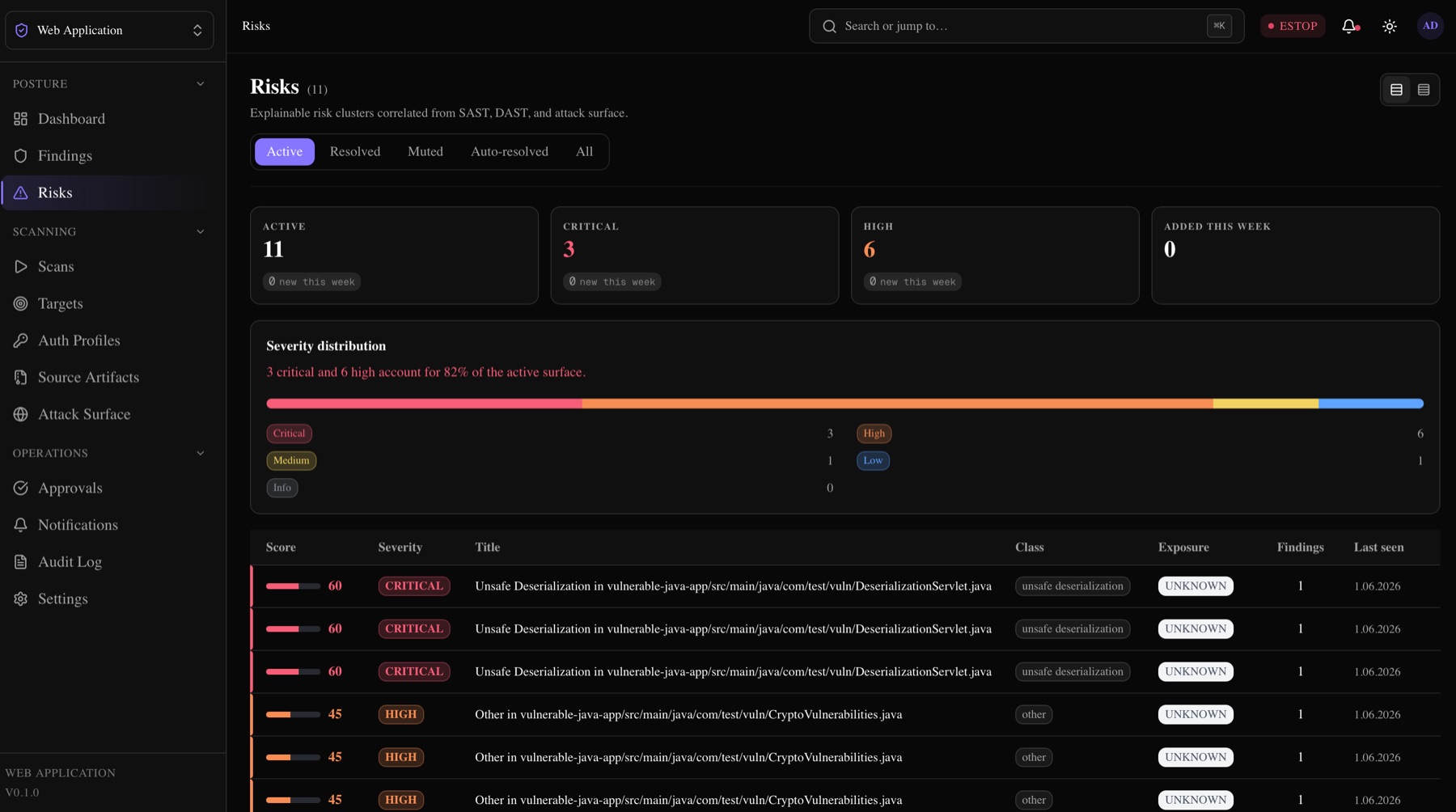
Deterministic fingerprinting collapses duplicate findings from different scanners into one. Every risk score carries an evidence chain showing exactly how it was derived.
Governance controls
Approval workflows including a two-person rule, SLA tracking, emergency stop, retention lifecycle, role-based access control, scoped API keys and OIDC single sign-on.
The interface
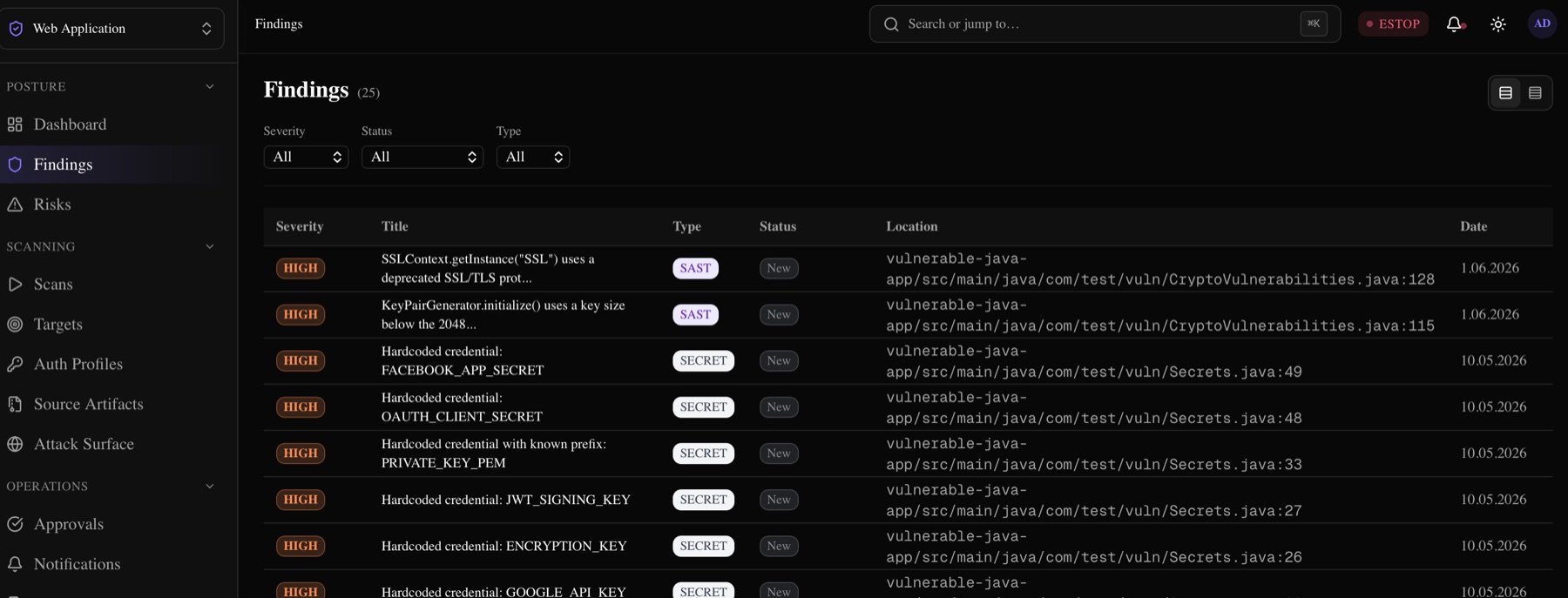
Captured from a running installation. The scanned target is a deliberately vulnerable sample application built for security testing.
Architecture
- 21 independent Go services — control plane, scan orchestration, SAST/DAST/browser/correlation workers, auth broker, audit, notification, retention and SLA services
- PostgreSQL 16 with row-level security for multi-tenant isolation
- NATS JetStream for work queues and eventing
- MinIO (S3-compatible) for evidence and artifact storage
- OPA for policy evaluation
- Next.js 16 and React 19 management interface
Deployment
Docker Compose for evaluation, Kubernetes and Helm for production. Air-gapped installations are supported.
The other half of the chain
SecureContext
Manage every finding through to closure
Let's discuss what this means for your organisation
Tell us where you stand today and we will work out together where to begin. A first conversation, no commitment.