Vulnerability Management Platform
SecureContext
ManagesManage every finding through to closure
Scanning is the easy part; closing findings is not. SecureContext consolidates vulnerability data from every scanner into one place and drives each finding through triage, exception handling, asset correlation, SLA tracking and compliance reporting until it is resolved.
Request a conversationThe vulnerability lifecycle
Ingest
One pool, every source
- Output from every scanner in use
- Asset inventory from the CMDB
- Known-exploit intelligence
Triage
An owner for every finding
- New → Reviewing → In Progress
- Engineer assignment and Jira ticket
- Severity and priority scoring
Disposition
Close it or justify it
- Closed as mitigated
- Seven exception types: approval, expiry, revalidation
- Linked to the asset and its business owner
Reporting
A position you can prove
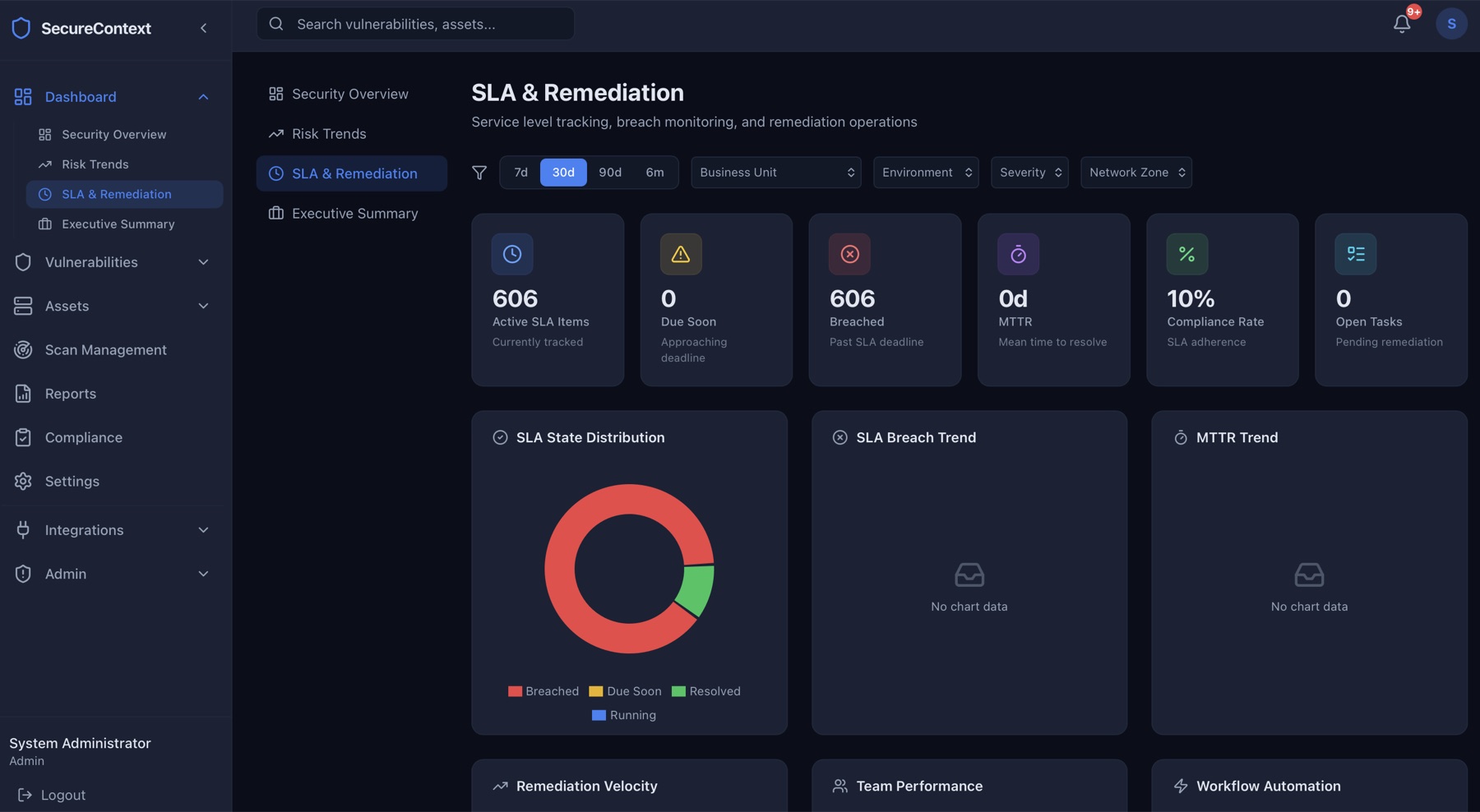
- SLA and MTTR dashboards
- CIS, PCI-DSS and HIPAA mapping
- Executive, technical and audit reports
Capabilities
Triage workflow
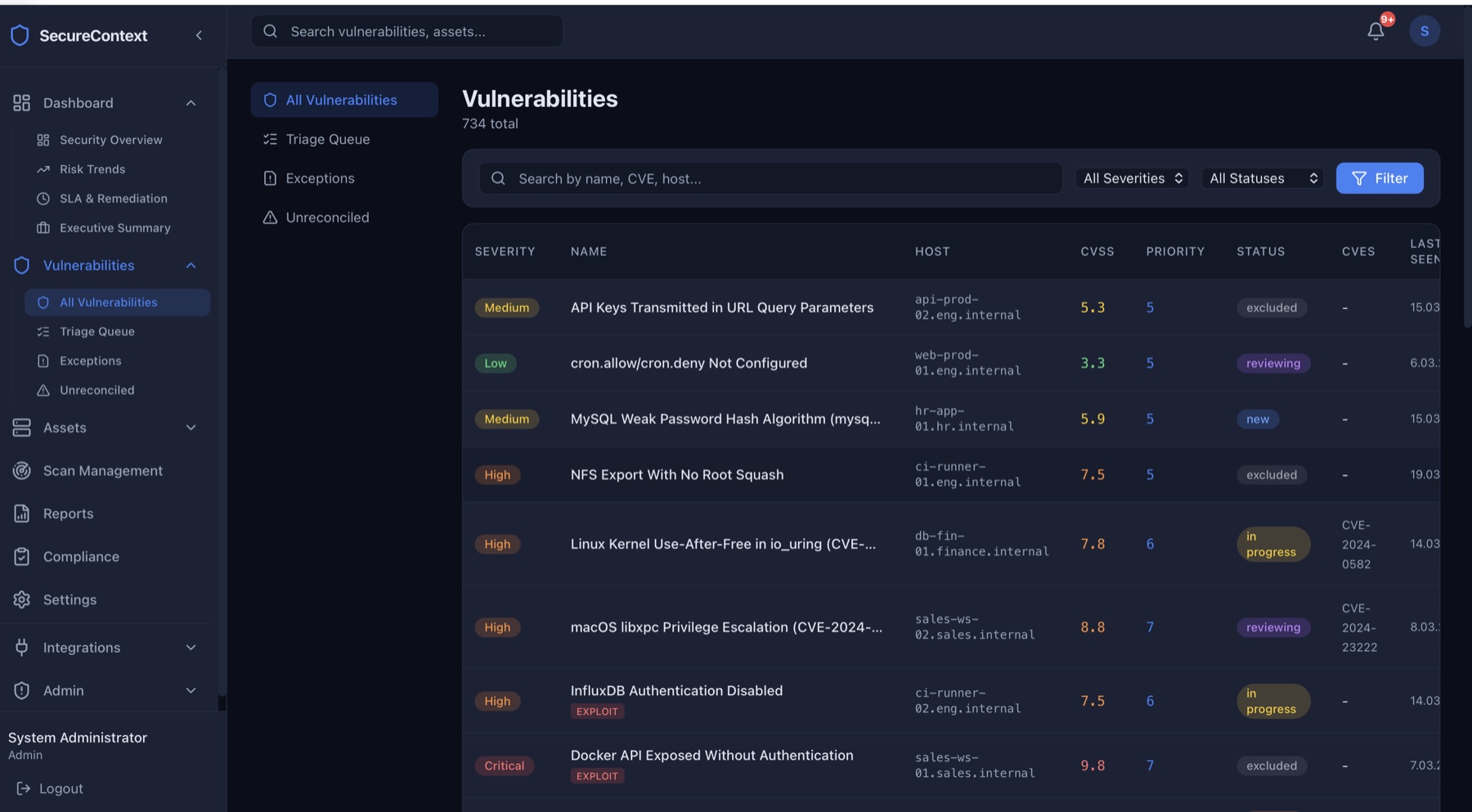
New → Reviewing → In Progress → Mitigated. Every finding gets an owner and a tracked state, so nothing quietly disappears into a backlog.
Exception management
Seven exception types — false positive, accepted risk, compensating control, policy-based, environment-based, decommission and manual. Each passes through approval, expiry and revalidation, so exceptions never become permanent by accident.
Asset management and CMDB correlation
Findings are tied to inventory assets and integrate with CMDB systems such as ServiceNow, making it clear which system and which business owner each vulnerability belongs to.
Bidirectional Jira integration
Raise tickets straight from a finding, in bulk when needed. Status changes in Jira flow back into the platform, so the two systems never drift apart.
Compliance mapping and reporting
Vulnerabilities map to CIS, PCI-DSS and HIPAA frameworks. Executive, technical and audit reports export as PDF, CSV or JSON.
Dashboard and SLA tracking
Severity distribution, network zone breakdown (Internet / DMZ / Internal), 30-day trend, most affected hosts, findings with known exploits and SLA compliance — on one screen.
The interface
Captured from a running installation; the data shown is illustrative.
Architecture
- Node.js REST API with a PostgreSQL 15 database
- Redis for caching, sessions and token management
- PgBouncer connection pooling
- Nginx reverse proxy and TLS termination
- Prometheus, Grafana, Loki and Alertmanager observability stack included
- Active Directory / LDAP authentication and user sync
Deployment
Installs on a single server via Docker Compose. Two cores and 4 GB of memory are sufficient; four cores, 8 GB and a 50 GB SSD are recommended.
The other half of the chain
SentinelCore
Find vulnerabilities in your code without sending it anywhere
Let's discuss what this means for your organisation
Tell us where you stand today and we will work out together where to begin. A first conversation, no commitment.